
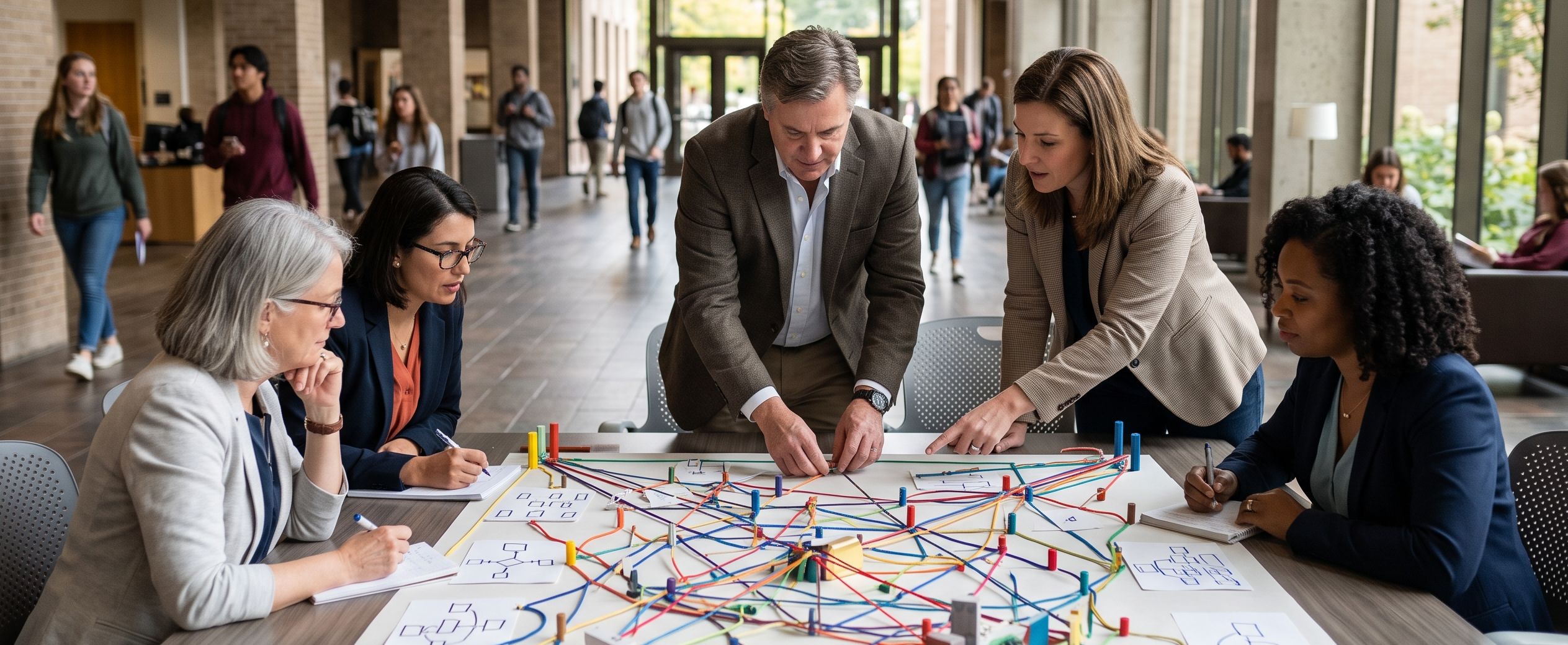

A new dean once told Dr. Kim Burns, a coaching colleague and former community college dean, that every decision she makes will leave someone unhappy. After all, executive leaders, faculty, staff, and students all have a stake, opinions, and aspirations, and these rarely align. That is why coaching middle managers has to start with the system, not the person.
That story surfaced earlier in a conversation with Kim on my podcast, Coaching in Higher Education, and it has stayed with me. It raised a question I now ask about my own work as an external coach: when we coach middle managers, are we helping change the conditions they work in, or only helping them endure those conditions?
My realization is somewhat uncomfortable: Coaching can quietly become a way for institutions to avoid the deeply transformational work they should continually do to maintain organizational agility in an ever-changing higher ed landscape.
When Coaching Becomes a Coping Mechanism
Much of the coaching offered to deans, directors, and coordinators centers on them learning to say no, delegate better, and set limits. That work certainly matters, and clients often tell me it is the first time they have discussed these shifts and the assumptions behind them out loud.
Yet despite all their efforts, middle manager clients return every day to an institution that still rewards the opposite behavior. They may now protect their weekends or involve more of their reports in decisions, but the surrounding system has not changed.
Higher education is notoriously poor at deciding what to stop doing. At the same time, we have already spent years doing more with less, and I believe we have reached the point of doing less with less. If I help a client absorb a workload the institution never questions, I have supported one person’s survival and made a difference in their life. Yet the pattern stays intact. Coaching is a powerful development tool, but its impact is limited under these circumstances.
Coaching Middle Managers as an Early Warning System
Deans, directors, and others in the middle of institutional hierarchies maintain strong vertical relationships and are uniquely positioned (and challenged) to know what senior leaders intend and what faculty and staff experience or expect. That vantage point makes them cultural translators by necessity, fluent in the institution’s dialect and in the realities it often obscures.
As external coaches, we sit outside the hierarchy, which is a privileged and powerful position. With client consent and strict confidentiality, I see an opportunity to help leaders notice patterns without exposing individuals: where workload concentrates, where decisions stall, where shared governance exists on paper only. The client’s story stays theirs, but the insights gained can become institutional intelligence used for broader transformation.
Treat Values as Data, Not Only a Compass
One exercise I find compelling asks clients to write down their core values and compare them with the values named in the strategic plan or on their institution’s About page. Then they compare both against the values the culture actually demonstrates. For the client, this can clarify hard decisions and deepen their understanding of their place in the organization. At the same time, for the institution, the gap between espoused and lived values is information, uncomfortable and probably unwanted, but salient nonetheless.
The bitterness many employees still feel about how the institution handled hybrid work after the pandemic is one example where that gap is visible. When a client’s values collide with the culture, I help them explore where they can exert influence, including job crafting, and, when it fits, whether a transition makes sense. When several clients describe similar conflicts, campus leaders had better take notice.
Democratizing Coaching Means Changing Its Purpose
Upper-level administrators are often used to coaching. Middle managers, on the other hand, often receive remediation, and those of us who support faculty and staff development are sometimes asked to “fix” an employee. That request misunderstands coaching entirely and is a red flag for me that I wish to think twice about agreeing to the engagement. Coaching is about building capacity, strengthening what works, and moving clients forward, not just making them better suited to standing still.
Democratizing coaching involves more than expanding access; we often need to raise awareness first. At community colleges, for instance, where coaching is largely unfamiliar and the culture is practical, mission-driven, and based on maximizing resources, we may first explain to leaders how coaching greatly enhances leadership development and why it is never a repair service. It also means building coaching into transitions and career conversations rather than reserving it for people in trouble.
Questions Worth Asking
When coaching middle managers, coaches can ask whether an engagement aims to help a client cope or to build influence and affect change within the system they work in. I also often wonder what administrators would learn if they asked and listened closely to the people in the middle, then used those insights to modify working conditions rather than just help clients endure them.
As I have written many times before, sustainable employee development, retention, and engagement depend on relational trust, and trust grows when an institution responds to what its people tell it safely and candidly. If we want the ripples of impact that come from coaching to last, we need to support individuals in finding their own solutions and help institutions act on what those individuals reveal.
If you lead a college or university and want leadership development for middle managers that supports both people and institutional change, or you are a coach looking to deepen your higher education practice. Check out my professional coaching and advisory services. Together, we can build future-ready middle-management leadership capacity for greater organizational agility.
You can find this and all other Coaching in Higher Education podcast episodes on:


| 
| 
| 
|
Frequently Asked Questions About Coaching Middle Managers in Higher Education
Why is coaching middle managers in higher education more than just about the individual?
Middle managers are often caught in the crossfire from the institution itself, such as being overloaded with work and fuzzy goals. If coaching just helps them cope, the pattern is still there and the same strain comes back.
How can coaching become a coping mechanism instead of a change tool?
When a coach helps a client absorb a workload the institution never questions, the person survives but the system does not change. Coaching works best when it also helps clients influence the conditions they work in.
Why are middle managers an early warning system for an institution?
Deans, directors, and coordinators sit between senior leaders and the people on the ground, so they see what both groups expect and experience. With client consent and confidentiality, coaches can help surface patterns without exposing individuals.
What does it mean to treat values as data in coaching?
Clients write down their core values and compare them with the values in the strategic plan and the ones the culture actually shows. The gap can clarify hard decisions for the client and give the institution useful information.
How can coaching reach community college leaders and other middle managers?
Coaching is often unfamiliar in community colleges, so it helps to first explain what it is and what it is not. Building it into transitions and career conversations, rather than reserving it for people in trouble, makes it far easier to accept.