

As external executive coaches and organizational development advisors to colleges and universities, we frequently observe leaders who are highly accomplished but deeply exhausted. In higher education, professionals experience a profound form of exhaustion that goes far beyond typical workplace stress.
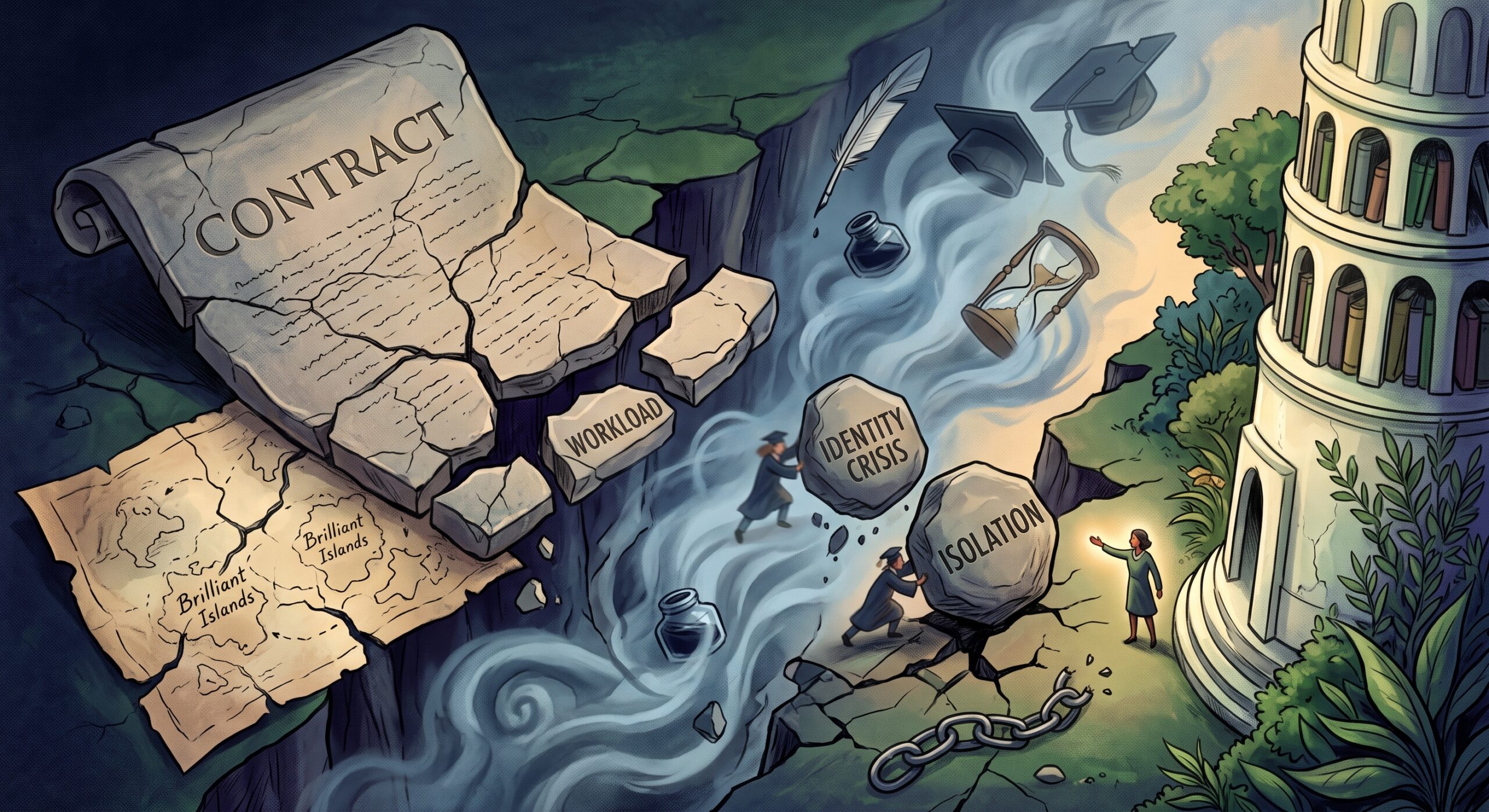
When I spoke with Dr. Rebecca Pope-Ruark, a certified professional coach, expert on academic burnout, and the author of several publications on this topic, to explore this critical issue on my podcast, Coaching in Higher Education, we came upon a perspective I had never considered: academic burnout is not merely a problem of excessive workload but fundamentally an identity crisis born from the ‘brilliant island’ illusion.
This is the internalized belief that an academic or administrator must operate as an isolated, self-reliant entity whose entire personal value is tied to intellectual output and competence. When this illusion collapses under chronic stress, the resulting professional identity crisis requires specialized, systemic support.
Shame and the “Furry Wall”
For coaches and campus administrators alike, understanding the unique psychology of academic burnout is crucial. The challenge is that academics and many higher education leaders are trained to value intellect and competence above all else, seeking validation almost exclusively through their professional roles.
When burnout strikes, it directly attacks this core identity of academics and educational administrators.
Rebecca described how academics facing burnout suddenly feel as if their brains are not working, experiencing a big, “furry wall” between themselves and their thought processes. Because competence is the primary currency on campus, in many cases, this cognitive block triggers deep personal shame.
Instead of recognizing burnout as a workplace stress syndrome, individuals blame themselves, assuming they simply cannot hack it anymore. This shame causes them to suffer in silence, retreating further into their isolated islands rather than seeking help.
Six Misalignments and Institutional Betrayal
To support their clients, coaches must look beyond individual coping mechanisms and address systemic mismatches, chronic workloads, and declining budgets that force staff and faculty to do more with less. But physical exhaustion is only one piece of the puzzle; value misalignment and emotional exhaustion are often far more destructive.
When an institution’s enacted, observable, or accepted behaviors contradict its stated values, employees experience a profound sense of institutional betrayal. This mismatch is one of the six key misalignments between workers and workplaces identified as early as 1999 by researchers Christina Maslach and Michael Leiter. For student-facing faculty and staff, this stress is compounded by secondary trauma as they struggle to support learners who are also navigating immense upheaval. Over time, this unresolved friction breaks the implicit contract between the employee and the institution, leading to cynicism, exhaustion, and a drop in professional efficacy.
Navigating the Three Levels of Burnout
When we work with campus clients, we must recognize which interventions are appropriate. To this end, Rebecca highlighted the three-stage burnout model developed by researcher Nick Petri, which provides an invaluable framework for coaches and administrators.
At the first level of standard stress, individuals benefit from setting boundaries and temporarily decoupling from work. In the middle level of chronic stress, clients must learn to say no and have direct conversations with supervisors. Here, coaching is highly effective by helping clients conduct values exercises, establish boundaries, and articulate their limits.
However, when a client reaches the third level of full-blown burnout, they may require medical leave and clinical therapy.
Since burnout at this stage is often comorbid with anxiety or depression, as coaches, we must maintain strict professional guardrails, knowing when to refer clients to licensed therapists who can help them untangle past trauma and separate their identity from their work.
Shifting from Mandated Self-Care to Compassionate Leadership
Preventing this systemic churn requires our institutions of higher learning to move beyond superficial wellness solutions – such as monthly emails about self-care, which can feel disingenuous to overworked staff – and to make well-being a funded, strategic priority.
Additionally, we must equip leaders at all levels with the skills to hold compassionate conversations: active, empathetic dialogues in which leaders listen to understand, ask supportive questions, and collaborate on short- and long-term adjustments. By building leaders’ capacity in these coaching techniques, institutions can dismantle a culture in which faculty are expected to be brilliant on their small “island” and instead foster communities built on authenticity, vulnerability, and psychological safety.
Addressing burnout is not only the right humane thing to do for today’s campus leaders; it is also essential for retaining valuable institutional knowledge and preventing costly administrative turnover.
Let’s help our clients learn to keep up their end of the campus contract!
If you are a university leader seeking to build a healthier, more sustainable professional development program on campus, or a coach looking to deepen your higher education practice, let us collaborate. I invite you to explore my professional coaching and advisory services, where we partner with institutions to design impactful leadership programs, establish coaching initiatives, and cultivate compassionate campus cultures.
Let us work together to build a more supportive environment, one client and one conversation at a time.
You can find this and all other Coaching in Higher Education podcast episodes on:


| 
| 
| 
|
Academic Burnout FAQs : Compassionate Leadership
Why self-care does not work for academic burnout?
The burnout in academia is often not just overwork, but a symptom of a deeper identity crisis. Many academics conflate their entire self-worth with their intellectual output. Thus, when they are exhausted, no amount of individual self-care can address the systemic mismatches causing it.
What is the “brilliant island illusion”? How is it related to burn-out?
It refers to the concept of academics and administrators as isolated, self-contained experts whose worth is determined only by their competence. Chronic stress, when it shatters this illusion, results in a much more profound crisis of professional identity than the ordinary fatigue associated with work.
What causes us to experience “institutional betrayal” leading to burnout?
When the actual practices within an organization contradict the stated values, employees feel deeply betrayed. And this gap between expectation and reality is one of several documented mismatches between workers and their workplace that are fueling cynicism and disengagement.
What are the three levels of burnout and how would coaching differ at each level?
It helps people to set boundaries and to take a step back, at the first level of standard stress. Coaching supports clients to set boundaries and speak directly to their managers in the middle, chronic stage. Clients might need medical leave, clinical therapy, and coaches will have to refer them to licensed professionals at the point of full-blown burnout.
What else can institutions do to combat burnout besides wellness programs?
Instead of sending generic wellness emails, institutions need to commit to building leaders’ capacity for authenticity, vulnerability, and psychological safety. This shift helps to break down the “brilliant island” culture, and creates real, systemic support, rather than placing the onus on individuals.