
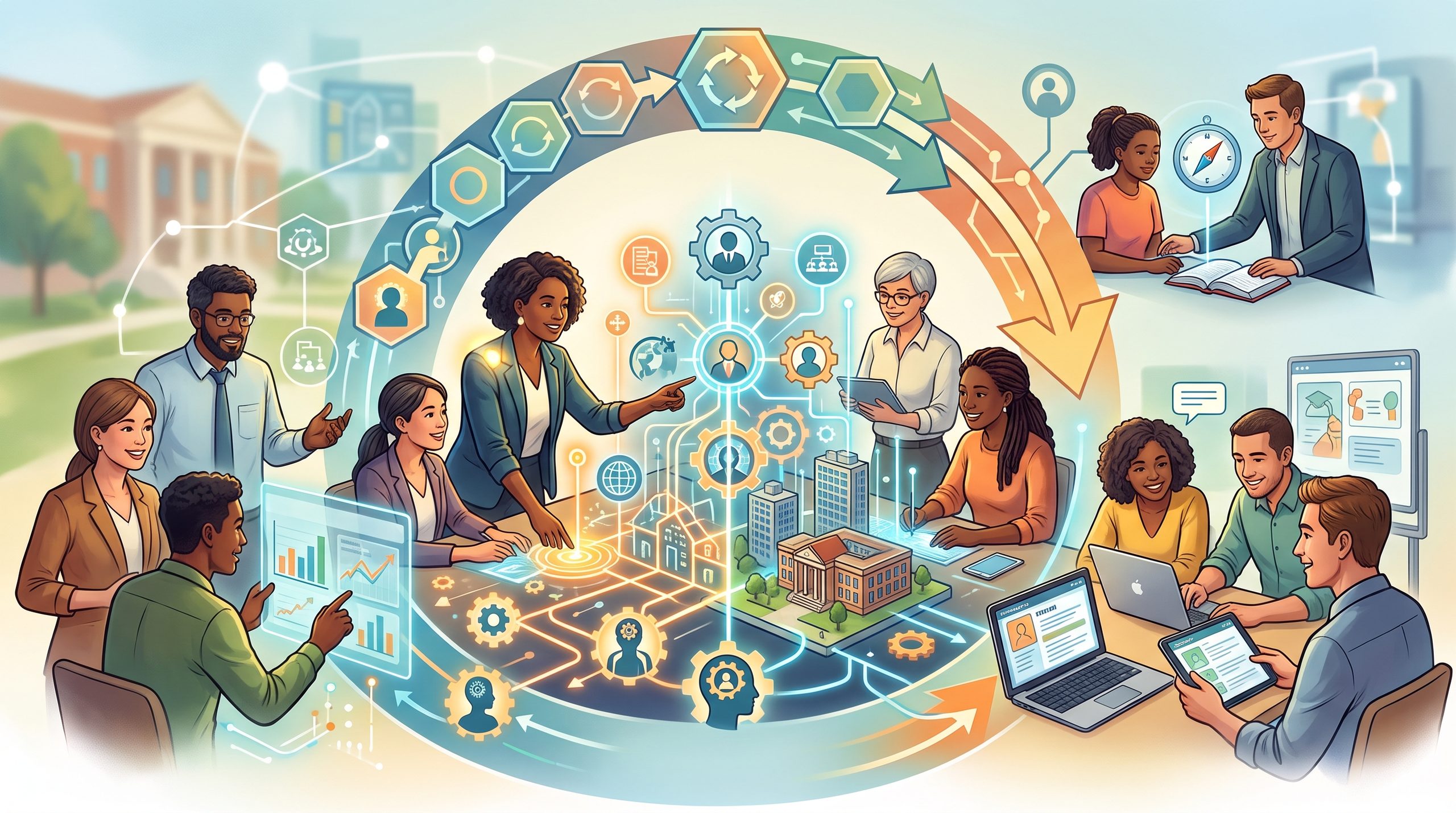

Online program transformation is frequently misdiagnosed as an infrastructure challenge where institutions invest in ed tech platforms, partner with service providers, and launch online degrees with high expectations, only to encounter organizational friction, administrative inertia, and persistent faculty resistance. When digital initiatives stall, decision-makers often blame market saturation or technology gaps.
Yet, as I learned in my conversation with Dr. Andrea Marcinkus, Senior Director of Research and Insights, and Dr. Aaron Wijeratne, Director of Academic Services, at Boundless Learning, the root cause is rarely technical. Instead, digital transformation in higher education fails when institutions treat software as the solution while ignoring the human and cultural systems that drive change.
Andrea and Aaron, who both transitioned from academic roles as faculty and chief academic officers into ed tech leadership, shared a critical insight for institutional leaders and executive coaches: sustainable online program expansion is not a transactional deal. It is a human-centered, cultural transformation that requires agile leadership coaching and deep empathy for academic identity.
This is where agile leadership coaching makes the difference.
Turning Data into Strategic Clarity
Colleges and universities generate massive amounts of operational and academic data, yet leadership decisions are still frequently driven by intuition or precedent. And when external data is introduced, campus stakeholders often view it with skepticism, fearing that market metrics will erode academic standards.
Andrea pointed out that true value of data lies in moving leadership teams from intuition to clarity. By integrating market search trends, employer skill requirements, and student performance metrics, leaders gain a clear picture of real-world demand. For professional coaches, the work involves helping institutional clients interpret this evidence without losing sight of institutional mission and helping leaders frame data not as a managerial whip, but as a decision-support tool that sharpens human judgment.
When leaders use data skillfully to illuminate opportunities rather than enforce compliance, they can help faculty and staff see how program evolution directly supports their students’ long-term success.
Navigating Faculty Identity and Resistance
The most complex hurdle in online learning transformation is not course design or software adoption; it is the perceived threat to academic identity. Faculty members devote their careers to mastering specific disciplines and refining their pedagogical craft. When asked to shift to online environments or incorporate generative artificial intelligence into course delivery, resistance often takes the form of skepticism or frustration.
As Aaron highlighted, faculty pushback usually stems from two core anxieties: a gap in technological confidence or a deep-seated fear that online delivery will compromise rigor and intellectual property.
Here, agile leadership coaching helps academic leaders look beyond surface-level resistance to uncover the issues behind the issues and support department chairs, deans, and program directors in creating psychologically safe environments where faculty can voice their concerns. By acknowledging professors’ emotional connection to their life’s work, coaches help leaders move away from top-down mandates and assist faculty in building new instructional capabilities, framing digital adaptation as an extension of their scholarly impact rather than a threat to their autonomy.
Agile Leadership Coaching Models Across the Campus Ecosystem
Standard executive coaching models often prove too rigid for higher education professionals. Since academics and administrators operate in complex, decentralized environments with distinct departmental norms, relying on what I’ve been called “pure coaching” may fall short of building meaningful buy-in.
Instead, digital transformation demands an agile – and (capital-A) Agile – coaching model, an approach that combines reflective inquiry with short coaching cycles, micro-learning, and ongoing capability development that may touch on training, facilitation, and mentoring. Through this multi-pronged approach, coaches can better help leaders build the capacity to model best practices, test new approaches iteratively in low-stakes environments with development teams, and reflect on outcomes over time.
As a certified Agile Coach, I have found that applying an Agile coaching mindset to client work more broadly also extends directly to student success, especially when institutions support learners through dedicated success coaches who help break down non-academic and navigational barriers, leading to significant increases in student retention rates. By aligning faculty development, administrative leadership, and student support, institutions establish a resilient ecosystem capable of continuous growth, whether within or beyond online program transformations.
Building impactful, sustainable online programs requires far more than launching courses on a digital interface. It demands clear strategic alignment, empathetic leadership, and a deep investment in the people who carry the institutional mission forward.
Whether you are a senior administrator seeking to modernize your academic portfolio or an executive coach supporting higher education clients through complex change, professional coaching offers the clarity and partnership needed to succeed. Explore my professional coaching and advisory services, as well as my work on Agile transformations of higher education administrative operations, to learn how we can partner with your institution to build resilient, future-ready leadership teams.
You can find this and all other Coaching in Higher Education podcast episodes on:


| 
| 
| 
|
Common Questions About Agile Leadership Coaching in Higher Education
Why do online programme transformations in higher education often stall?
Infrastructure problems are the usual suspects, but the real barriers are organisational friction, administrative inertia and faculty resistance. Success is about change, and change is human and cultural.
What’s the difference between agile leadership coaching and regular executive coaching?
Standard models may be too rigid for decentralised campuses. An agile approach uses short coaching cycles, micro-learning and continuous capability development so leaders can experiment with ideas in low stakes settings and adapt as they go.
How resistant are faculty to online and AI-enabled teaching?
Resistance can come from two concerns: a lack of confidence with the technology and a fear that online delivery will undercut rigour and intellectual property. Coaches help leaders get at the identity issues underlying the pushback.
How can coaching help leaders get more from data?
Coaches support leaders as they shift from intuition to evidence, bringing together market trends, employer skill needs and student performance data. The goal is to use data to inform decisions, not to enforce compliance.
How does agile coaching help students to succeed after the online programme?
Faculty development, administrative leadership, and student support (including success coaches) are aligned to create a resilient ecosystem.This could lead to better retention for students, whether or not the work is done online.