
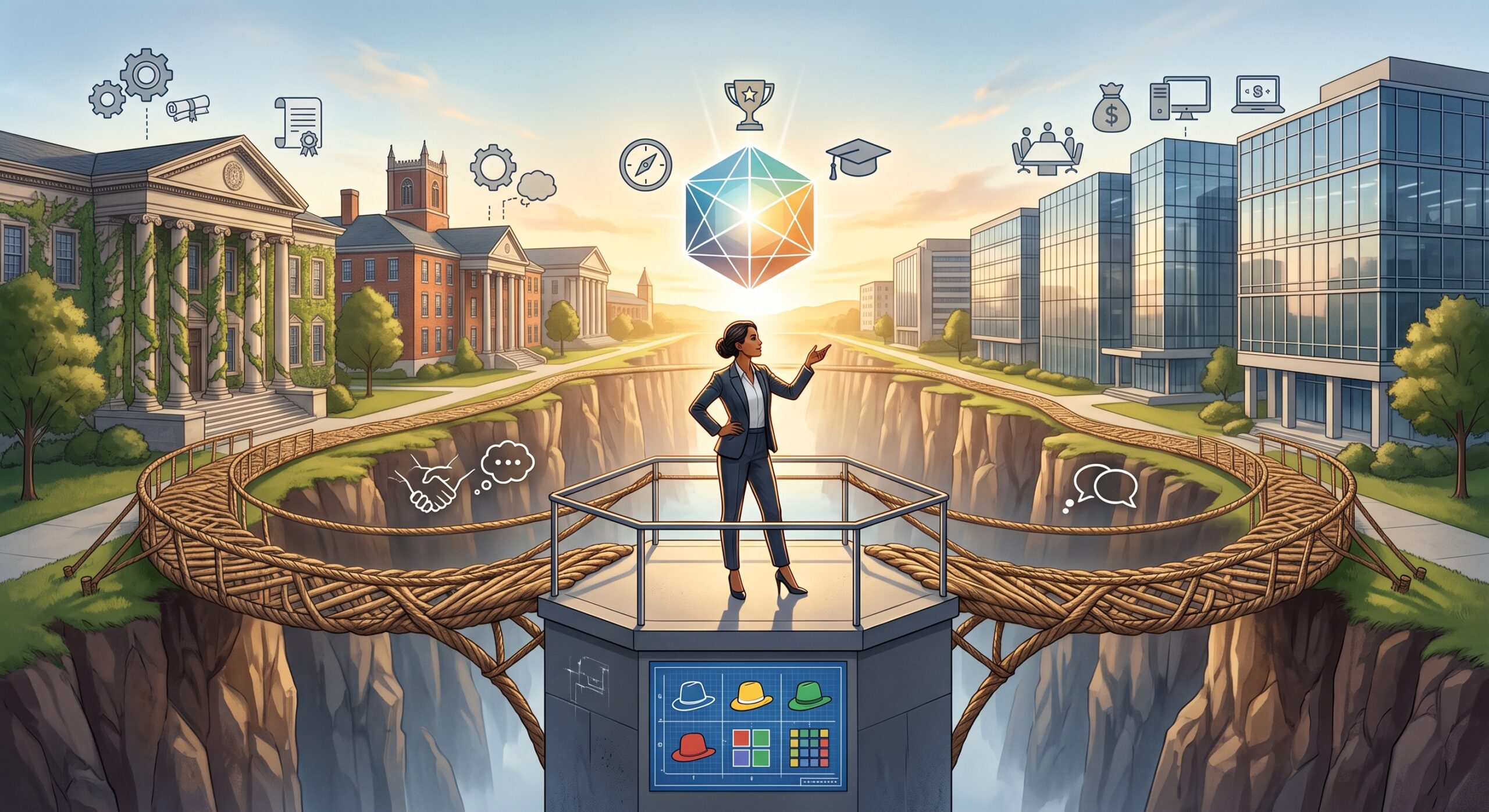

What puzzles me to no end is how many higher education leaders still view and treat their institutions as mechanical systems that can be overhauled with a new strategic plan handed down from the President’s office or “fixed” by replacing a proverbial squeaky wheel in the form of an employee who won’t fall in line.
What they seem not to understand – or, in some cases, blatantly ignore – is that colleges and universities are complex human ecosystems. So, when institutions struggle to achieve strategic goals, the underlying breakdown is rarely a lack of ambition, vision, or direction. Instead, it stems from internal misalignment across deeply entrenched functional, administrative, and academic silos, far beyond any structural obstacles, that nip many initiatives in the proverbial bud.
As I discussed with my good friend and coaching colleague, Dr. Mo Sattar, on my podcast, Coaching in Higher Education, organizational misalignment greatly affects institutional effectiveness. However, external professional coaches can help leaders tackle these challenges and serve as competent outsiders: coaches and advisors with deep knowledge of the higher education ecosystem and its unique challenges, who maintain a perspective only a third-party service provider can ensure and foster relational trust and shared understanding across campus.
Uncovering Hidden Indicators of Misalignment
The devious nature of institutional misalignment is that, while visible conflict is easy to spot, its absence often shows up as quiet friction, slow progress, and passive resistance. Higher education outcomes are messier than a typical for-profit business. Different departments chase different priorities, and their success metrics often pull in opposite directions.
Consider the ongoing tension around student retention as one (and very much simplified) example: Admissions teams are measured on enrollment targets, while faculty focus on academic standards and student preparedness. When student attrition occurs, faculty may feel that admissions is enrolling underprepared students, while admissions leaders believe faculty either lack adequate support mechanisms or apply unreasonable standards. This misalignment creates friction and ongoing mutual frustration.
Supplementing Broad Dialogues with Tangible Frameworks
While many campuses are comfortable hiring traditional management consultants, they may be cautious about solving systemic issues with professional coaches and outright suspicious of coaches who ask open-ended questions and generate client insights rather than assessing the status quo and issuing a catalog of solutions.
As executive coaches in higher ed, our role is not to direct or dictate solutions to campus leaders. Instead, we help clients build awareness of these systemic tensions so they can create their own sustainable solutions. To support leaders effectively, coaches must also provide tangible frameworks that create clarity and encourage constructive problem-solving.
What I learned from Mo is how combining behavioral diagnostics – for instance, the DiSC assessment with the Competing Values Framework – can serve as impactful tools to help leadership teams understand their working styles and team dynamics, as well as behavioral and communication preferences. Making these dynamics visible can help to build mutual empathy and relational trust.
Bridging Administrative Needs and Academic Autonomy
A major challenge in higher education leadership is the divide between senior administration and faculty culture: administrative leaders may face pressing financial pressures and board-level budget constraints, while faculty view their academic programs as deeply nurtured creations. When top-down mandates are perceived to strip away academic autonomy without explaining the strategic why and how they may affect individual faculty agendas, resistance naturally follows.
Here, external leadership coaches act as cultural translators and bridges. We are uniquely equipped to lead senior executives toward a deeper understanding of faculty’s motivational drivers, while supporting academic chairs and deans in aligning departmental goals with the broader institutional purpose.
Mo is a master at using change management models like Prosci ADKAR to build shared purpose, alongside structured prioritization tools like Six Thinking Hats and impact-feasibility matrices. In this way, professional coaches can support institutions in executing change collaboratively by aligning internal roles, execution processes, and communication channels.
The ripples of impact that greater alignment creates extend far beyond individual leadership teams, enhancing overall institutional performance and student success.
Transforming Higher Education Through Human-Centric Leadership
Achieving strategic alignment in higher education requires far more than top-down mandates or generic corporate advice. Through my conversations with Mo, I’ve learned that achieving this goal requires not only a human-centric approach and deep institutional empathy, but also structured processes that empower leaders to build their own alignment.
Who is better equipped to help institutions realize their potential than professional coaches who serve colleges, universities, and their leaders as competent outsiders?
If you are a higher education executive, dean, or administrative leader seeking to break down operational silos, enhance institutional effectiveness, or establish impactful professional development on your campus, I invite you to explore my professional coaching and advisory services.
Together, we can support your institution and bridge strategic vision with human-centered execution.
You can find this and all other Coaching in Higher Education podcast episodes on:


| 
| 
| 
|
Frequently Asked Questions About Strategic Alignment in Higher Education
What is a “competent outsider” in higher education leadership?
A competent outsider is an executive coach who knows the higher education ecosystem but is not caught up in the internal politics of the institution. That distance lets them spot patterns of misalignment that people inside the system often can’t see.
How does institutional misalignment usually show up on campus?
It rarely looks like open conflict. More often, it takes the form of quiet friction, slow progress, and passive resistance — when admissions teams chase enrollment targets while faculty push back on academic standards, and each side becomes frustrated with the other.
What frameworks help build strategic alignment?
Tools like the Disk behavioral assessment, the Competing Values Framework, Prosci ADKAR, and Six Thinking Hats can help leadership teams create a common language for understanding each other’s working styles and for prioritizing change.
How do coaches bridge administration and faculty?
Coaches act as cultural translators. They enable senior administrators to understand what really motivates faculty, and they help department chairs and deans connect their everyday objectives to the larger strategic vision of the institution.
Why does lasting change need a human-centric approach?
Because top-down mandates alone rarely stick. Leaders need structured processes that build their own understanding and ownership of a problem — that’s what makes the resulting change sustainable rather than resented.