

As coaches and leadership advisors to colleges and universities, we often see academic institutions struggling with deep administrative silos where leaders work in parallel rather than together and at times even negate each other’s efforts.
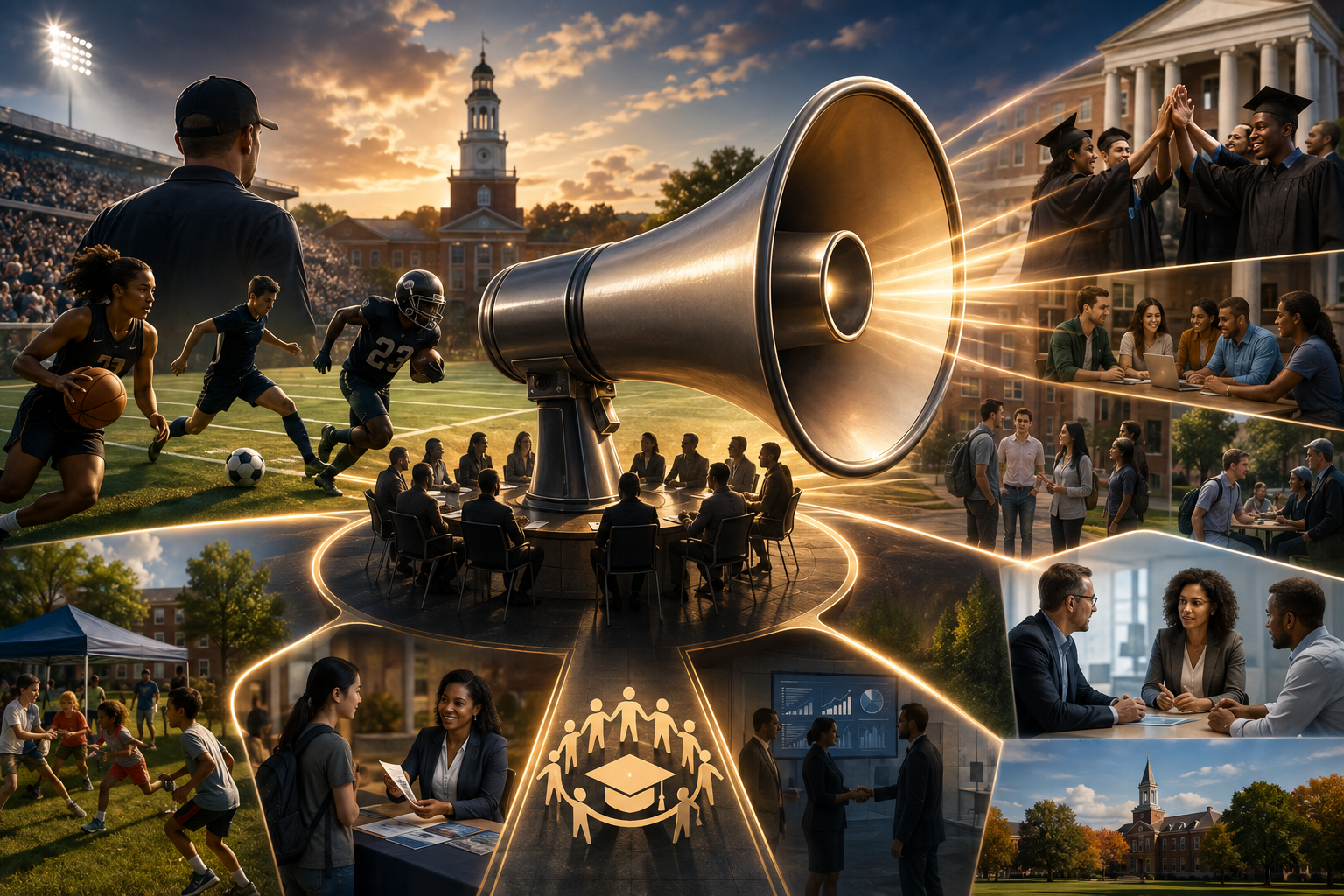
One crucial player in bundling strategic initiatives, as I discovered in my conversation with Tanya Vogel, former athletic director and Associate Vice President of Athletics at George Washington University, on my podcast, Coaching in Higher Education, is a university’s or college’s athletics program: Instead of viewing collegiate athletic operations as isolated commercial silos, institutions should treat them as integrated organizational megaphones and high-performing leadership laboratories for the entire campus.
Beyond the Front Porch: Athletics as an Enterprise Megaphone
Many of you will associate collegiate athletics with the flashy, multi-billion-dollar brands of major conferences. In fact, a 2023 report by The Knight Commission on Intercollegiate Athletics projected that annual revenues for the top 54 public football schools will reach more than $16 billion by 2032. Yet these represent only 4% of all programs, while the vast majority of the approximately 1,300 programs in the United States are heavily subsidized by their home institutions.
Although athletics is highly visible and often called the front porch of a university, its true value lies in its ability to serve as an enterprise megaphone, especially when external coaches help athletic directors align with the academic mission and leverage their programs as a powerful partner for other units.
Not only can athletics feature campus leaders on game broadcasts; athletic departments can also partner with enrollment management on summer camps to bring prospective students to campus early and boost enrollment or collaborate with student affairs to mobilize attendance at campus events. Such a holistic systems approach transforms athletics into a collaborative partner solving institutional pain points.
Learning Laboratories for Future Leaders
The benefits of more fully and deliberately integrating athletics into the educational campus ecosystem extend directly to student development. The image Tanya painted was that of athletics as a high-stakes learning laboratory where student-athletes are required to show up daily to collaborate, receive real-time feedback, manage emotional responses, and learn from failure.
I don’t believe the potential for such an environment to build essential competencies for the corporate world – or any job, for that matter – can be understated. For instance, according to Tanya, 94% of women serving in corporate executive suites played sports, and 52% played at the collegiate level, with student-athletes bringing rigorous discipline and a feedback-resilient mindset into classrooms, directly benefiting not only themselves but also their peers.
But running an effective “laboratory” and leadership incubator requires deliberate, informed, and skillful leadership from those running athletics programs. In the United States, there is no required certification to coach sports in higher education, while job postings often require only a basic degree from applicants with little or no proven experience modeling the leadership behaviors, attitudes, dispositions, and emotional intelligence essential to building a student-athlete’s resilience, determination, and skills in leading both self and others.
The Strategic Ripple of Institutional Coaching
Admittedly, leading a highly visible campus department brings immense professional pressure, as athletic directors and head coaches face constant scrutiny and the threat of termination. This intense environment can lead to reactive decision-making that negatively ripples through the entire institution.
To counteract these tendencies, professional leadership coaching provides a space for campus athletic leaders to shift from reacting to responding thoughtfully under tremendous scrutiny.
I believe it is important to emphasize that, for university administrators, investing in professional executive coaching for athletic and academic leaders is a highly sustainable development strategy that directly enhances talent recruitment, boosts retention, and fosters an authentic culture of collaboration.
Build a More Collaborative Campus Culture
Creating a cohesive, high-performing higher education institution requires moving past administrative silos and embracing mutual support. If you are a university administrator looking to design impactful professional development programs, or a professional coach seeking to deepen your work on campus, let us partner together.
I invite you to explore my professional coaching and advisory services, where we specialize in helping institutions design systemic coaching programs, train leaders, and build highly collaborative campus environments. Together, we can unlock the full potential of your leadership teams and create a lasting positive impact across your entire campus.
You can find this and all other Coaching in Higher Education podcast episodes on:


| 
| 
| 
|
Frequently Asked Questions: College Athletics as a Leadership Laboratory
What does it mean to treat college athletics as a campus leadership laboratory?
It means viewing the athletic department not as a stand-alone commercial silo, but as a connected hub for the entire campus where student-athletes and coaches build real leadership skills every day through collaboration, feedback and learning from failure.
How does college athletics benefit students beyond sports itself?
According to the post, a large share of women in corporate executive roles played sports in college, because the discipline and feedback-resilient mindset built through athletics carries directly into future careers.
Why is professional coaching important for athletic directors and campus leaders?
Athletic directors and head coaches work in the spotlight, under the gun, and that can lead to knee-jerk reactions. Professional leadership coaching helps them shift from reacting to responding thoughtfully.
Is a standard qualification required to coach college athletics in the US?
No. The post notes there is no required certification to coach sports in higher education, and most job postings ask only for a basic degree, without proven experience in modeling leadership behavior.
How can universities move past administrative silos using athletics?
Athletic departments can partner directly with other units, such as teaming up with enrollment management on summer camps to bring prospective students to campus, or with student affairs to boost attendance at campus events, turning athletics into a collaborative partner across the institution.